Welcome to the weekly Flow Cytometry Technical Series, a comprehensive resource designed to demystify the complexities of flow cytometry and empower researchers, students, and technical specialists with the knowledge to excel in their experiments. This series delves into the core issues and advanced applications of flow cytometry, offering detailed technical analysis and practical solutions.
What to Expect?
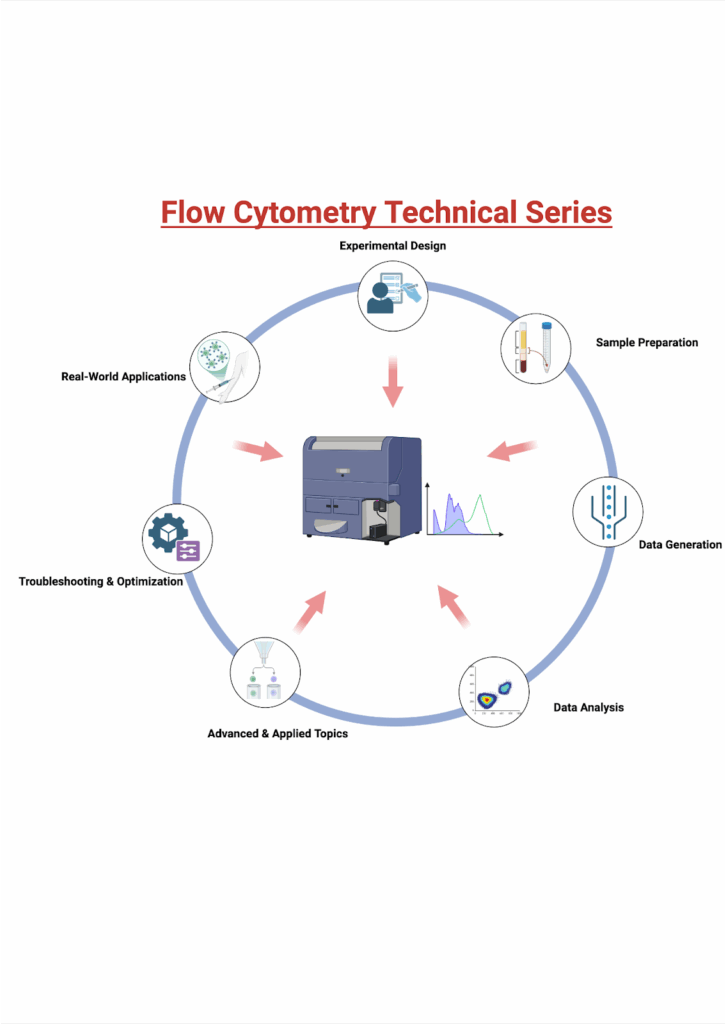
This weekly series is structured to guide you through every critical aspect of flow cytometry, from foundational principles to advanced troubleshooting and real-world applications. You can anticipate discussions across the following key areas:
- Experimental Design and Strategy: Learn how to design robust flow experiments that yield clear and meaningful results, covering everything from defining biological questions to statistical planning.
- Sample Preparation: Master the art of preparing your samples, ensuring the highest quality data by understanding best practices for collection, preservation, single-cell suspensions, and staining protocols.
- Data Generation (Instrument & Acquisition): This section will cover instrument setup, compensation theory and the nuances of spectral vs. conventional flow cytometry, etc.
- Data Analysis: Transition from raw data to biological insights with guidance on gating strategies, manual vs. automated approaches, high-dimensional analysis tools (t-SNE, UMAP, FlowSOM), and best practices for data presentation and archiving.
- Advanced & Applied Topics: For those ready to explore beyond the basics, this section covers spectral unmixing, flow cytometry in clinical trials, cell sorting (FACS), and high-throughput automation workflows.
- Troubleshooting & Optimization: This “bench-side buddy” section will equip you with solutions to common problems, including sample prep errors, high background, gating drift, compensation issues, and instrument artifacts.
- Translational & Real-World Applications: Discover how flow cytometry is applied in immuno-oncology, infectious disease research, biomarker discovery, and clinical settings, showcasing its impact on translational outcomes.
Each section is designed to provide both the “why” and “how to fix” with technical detail, ensuring you gain a thorough understanding of the principles and practical skills needed for successful flow cytometry. Get ready to enhance your expertise and confidently navigate the world of flow cytometry!
Disclaimer
The editors take care to share authentic information. In case of any discrepancies please write to newsletter@medness.org
The sponsors do not have any influence on the nature or kind of the news/analysis reported in MedNess. The views and opinions expressed in this article are those of the authors and do not necessarily reflect the official policy or position of MedNess. Examples of analysis performed within this article are only examples. They should not be utilized in real-world analytic products as they are based only on very limited and dated open-source information. Assumptions made within the analysis are not reflective of the position of anyone volunteering or working for MedNess. This blog is strictly for news and information. It does not provide medical advice, diagnosis or treatment nor investment suggestions. This content is not intended to be a substitute for professional medical advice, diagnosis, or treatment. Always seek the advice of your physician or another qualified health provider with any questions you may have regarding a medical condition. Never disregard professional medical advice or delay in seeking it because of something you have read on this website.
MedNess is a part of STEMPeers® which is a 501(c)(3) organization registered in PA as PhD Career Support Group. The organization helps create a growing network of STEM scientists that is involved in peer-to-peer mentoring and support.