Zellweger spectrum disorders (ZSD) are a group of rare, inherited conditions caused by mutations in genes responsible for building peroxisomes—tiny structures inside our cells that are crucial for breaking down fatty acids and supporting brain development. Though once considered distinct diseases, conditions like Zellweger syndrome, neonatal adrenoleukodystrophy (NALD), and infantile Refsum disease (IRD) are now understood as part of a spectrum, reflecting varying severity of the same underlying biochemical dysfunction.
Clinical Description, classification and symptoms
| Classification Level | Disorder |
| Prevalence | NA |
| Age of Onset | Neonatal |
| Inheritance | Autosomal dominant |
ZSD is caused by mutations in one of at least 13 different PEX genes, with PEX1 being the most affected. These genes produce proteins known as peroxins that are vital for assembling functional peroxisomes. Without functional peroxisomes, cells cannot efficiently metabolize certain lipids, leading to the accumulation of toxic substances and widespread tissue damage.
Because ZSD follows an autosomal recessive inheritance pattern, an affected child inherits two non-working copies of a PEX gene—one from each carrier parent. Zellweger syndrome (ZS), the most severe end of the spectrum, typically presents at birth. Affected infants often display distinctive facial features such as a broad nasal bridge, high forehead, up-slanting eyes, and flattened facial structures. These physical signs are accompanied by severe neurological impairments, including profound hypotonia (low muscle tone), seizures, and psychomotor delay. Skeletal abnormalities, especially in the hips and knees (chondrodysplasia punctata), are common, as are subcortical kidney cysts. Liver dysfunction is another hallmark, leading to hepatomegaly, jaundice, coagulopathy, and failure to thrive. Eye and ear involvement are also significant, with patients experiencing progressive vision loss due to cataracts, glaucoma, and retinal degeneration, as well as sensorineural hearing loss. Additional symptoms may include genital anomalies like cryptorchidism or clitoromegaly and notable head size variations such as macrocephaly or microcephaly.
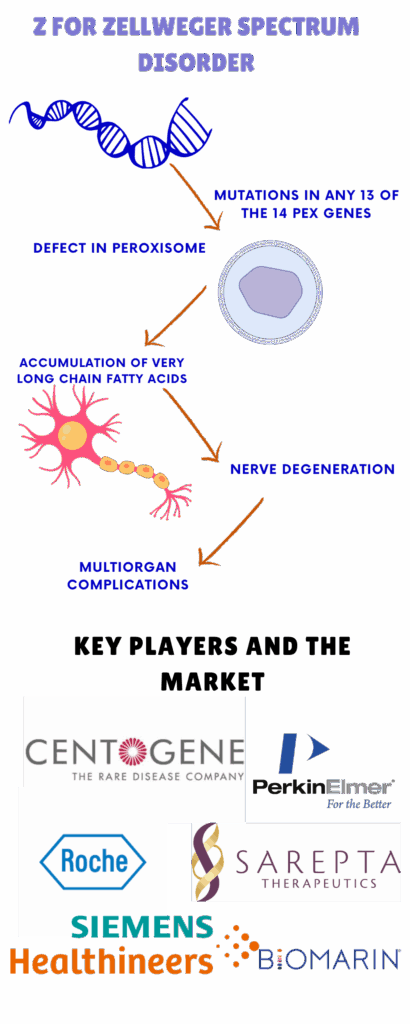
Figure: Zellweger Spectrum Disorder, Image Source: https://www.youtube.com/watch?v=RdMdPnCzxNI
Diagnosis and Treatment
Diagnosis is based on clinical presentation and confirmed through biochemical markers such as elevated very-long-chain fatty acids (VLCFAs), reduced plasmalogens, and increased plasma pipecolic acid, alongside genetic testing and MRI imaging, which may show developmental brain anomalies like perisylvian polymicrogyria. ZSD must be distinguished from other peroxisomal disorders, single-enzyme defects, and conditions with similar symptoms. Prenatal diagnosis is possible through biochemical assays on amniocytes or chorionic villi and DNA testing if pathogenic variants are known. Management is supportive, including seizure control with antiepileptics, treatment of liver-related coagulopathy with vitamin K, fat-soluble vitamin supplementation, dietary restrictions on phytanic acid, and nutritional support via gastrostomy if necessary. Supplementation with DHA and bile acids may benefit some patients with liver involvement. Despite interventions, the prognosis remains poor, with most affected infants not surviving beyond the first year due to respiratory complications or intractable seizures.
In 2015, Cholbam (cholic acid) became the first approved treatment for patients with peroxisomal disorders like ZSD, targeting bile acid synthesis issues. Management of ZSD typically requires a multidisciplinary team, including pediatricians, neurologists, endocrinologists, and other specialists to address the broad spectrum of symptoms. Supportive treatments may include feeding via gastrostomy tube, anti-epileptic drugs for seizures, vitamin K for bleeding complications, hearing aids or cochlear implants, vision correction, and surgery for cataracts. Adrenal insufficiency is common in intermediate forms, necessitating annual hormonal testing and possible adrenal hormone replacement therapy (e.g., Cortef). Bone health is also a concern due to reduced bone mineral density, so bone and dental evaluations are recommended. Early intervention through special education, physical therapy, and services for children with deaf-blindness can improve quality of life. Genetic counseling is advised for affected families to guide reproductive decisions.
Although there is no cure for ZSD, early diagnosis and supportive management can improve quality of life, particularly for individuals with milder forms. Awareness of this condition remains low, underscoring the importance of continued advocacy, education, and research. ZSD market estimated to be 350 million in 2023 has been projected to grow to 600 million by 2033.
Explore more resources and support groups for Zellweger syndrome.
Sources
- https://rarediseases.org/rare-diseases/zellweger-spectrum-disorders/
- https://www.orpha.net/en/disease/detail/912
- https://www.databridgemarketresearch.com/reports/global-zellweger-spectrum-disorders-market
-Dr. Malini Gupta, Ph.D.
Disclaimer
The editors take care to share authentic information. In case of any discrepancies please write to newsletter@medness.org
The sponsors do not have any influence on the nature or kind of the news/analysis reported in MedNess. The views and opinions expressed in this article are those of the authors and do not necessarily reflect the official policy or position of MedNess. Examples of analysis performed within this article are only examples. They should not be utilized in real-world analytic products as they are based only on very limited and dated open-source information. Assumptions made within the analysis are not reflective of the position of anyone volunteering or working for MedNess. This blog is strictly for news and information. It does not provide medical advice, diagnosis or treatment nor investment suggestions. This content is not intended to be a substitute for professional medical advice, diagnosis, or treatment. Always seek the advice of your physician or another qualified health provider with any questions you may have regarding a medical condition. Never disregard professional medical advice or delay in seeking it because of something you have read on this website.
MedNess is a part of STEMPeers® which is a 501(c)(3) organization registered in PA as PhD Career Support Group. The organization helps create a growing network of STEM scientists that is involved in peer-to-peer mentoring and support.